
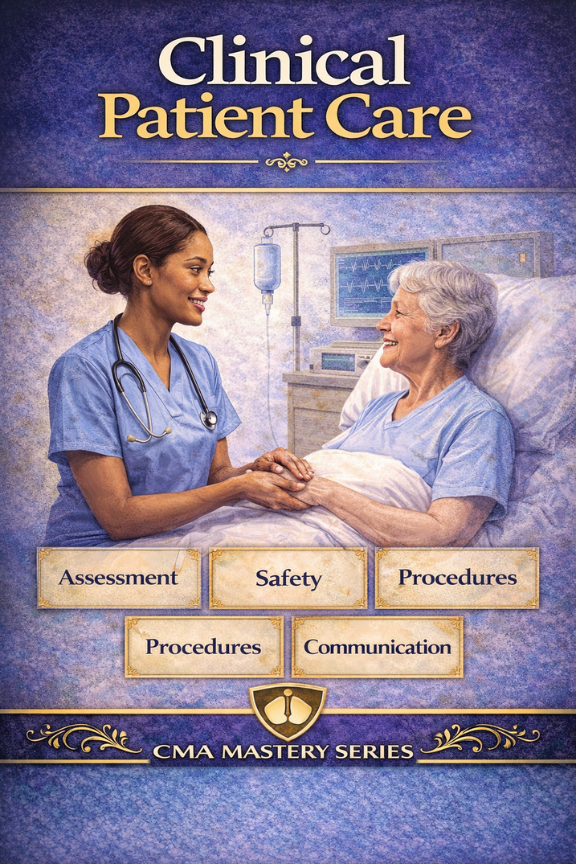
Clinical Patient Care Guide
Comprehensive Digital Healthcare Training
$12.99$5.00
Enhance your clinical skills with this digital guide, designed for healthcare professionals and students. Covering essential topics like patient assessment, safety, procedures, and effective communication, this resource helps you achieve mastery in patient care settings. Part of the CMA Mastery Series, it offers evidence-based content and interactive modules to ensure you’re well-prepared for real-world scenarios.
🧼 Infection Control & Safety
🔹 Standard Precautions
Used for all patients, regardless of diagnosis.
Hand hygiene before & after patient contact
Gloves when exposure to blood or body fluids is possible
Masks, gowns, eye protection as needed
🔹 Transmission-Based Precautions
Contact: Gloves & gown (MRSA, C. diff)
Droplet: Mask (flu, strep)
Airborne: N95 respirator (TB, measles)
🔹 Hand Hygiene
Soap & water: visibly soiled hands
Alcohol-based sanitizer: routine cleaning
The most effective way to prevent infection
💉 Medication Administration
🔹 The Five Rights
Right patient
Right medication
Right dose
Right route
Right time
🔹 Injection Sites
IM: Deltoid, ventrogluteal, vastus lateralis
Subcutaneous: Abdomen, thigh
Intradermal: Forearm
🔹 Safety Tips
Verify allergies
Never recap needles
Dispose of sharps immediately
Document after administration
🧍 Patient Positioning Guide
Position | When to Use Position |
|---|---|
Supine | |
Fowler’s | |
High Fowler’s | |
Sims’ | |
Lithotomy | |
Prone | |
Trendelenburg |
🩸 Vital Signs Overview
Normal Adult Ranges
Temperature:
Pulse:
Respirations:
Blood Pressure:
Oxygen Saturation:
When to Report
Fever above
Pulse below or above
BP
Shortness of breath
🧪 Specimen Collection & Phlebotomy
Key Points
Verify patient identity
Label specimens in front of the patient
Use proper tube order
Dispose of sharps correctly
Common Sites
Adults: Median cubital vein
Infants: Heel stick
🧠 Documentation & Legal Responsibilities
Proper Documentation Includes:
Date & time
Objective information only
Correct spelling
No erasing (single line correction + initials)
Legal Considerations
HIPAA compliance
Patient confidentiality
Scope of practice
Informed consent
🚨 Emergency Awareness
Common Emergencies
Syncope (fainting)
Hypoglycemia
Shortness of breath
Chest pain
Immediate Actions
Stay calm
Call for help
Position the patient safely
Document incident
🧠 CMA Exam Tips
✔ Always choose patient safety first
✔ Follow the scope of practice
✔ Use standard precautions
✔ When in doubt → report to provider
✔ Documentation matters
📌 Quick Study Reminder
“If it protects the patient, prevents infection, or ensures safety — it’s usually the correct answer.”